

Raziel / NUS FinTech Lab
Proof-backed access for AI agents
Let agents work across services. Give each one a grant for the data it needs, backed by proof that the owner’s rule was met.
Prof. Jungpil Hahn (Advisor) · Gita Alekhya Paul
Why trust is harder to scale for agents
In 42 seconds, follow one agent’s request and see what a proof adds to Bob’s access check.
Read the explainer transcript
- One agent, one read. A service checks whether the agent can read a document.
- Many agents, many decisions. Agents plan tasks and call across services. Each task can involve several access decisions. A service that accepts the issuer’s decisions inherits mistakes in those decisions across its protected calls.
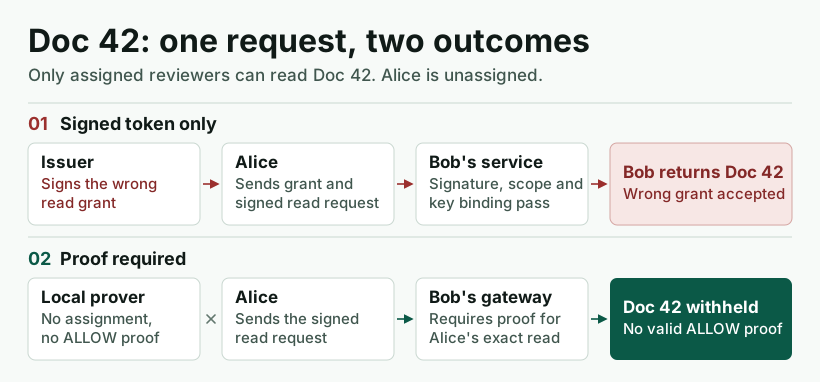
- The Doc 42 rule. Only assigned reviewers can read Doc 42. Alice requests it, but she has no assignment.
- A wrong grant with a correct signature. The issuer makes a mistake and signs a grant for Alice. Bob checks the OAuth access token’s issuer, signature, audience and expiry. Those checks pass. Bob accepts the grant in this setup, relying on the issuer to apply the reviewer rule.
- Raziel requires a proof of permission. An independent verifier checks proof that the approved rule and committed relationship facts permit this exact grant. Alice has no assignment, so the gateway receives no valid proof and withholds Doc 42.
- Verification at the access boundary. A permitted agent can reuse its grant. The gateway checks each signed request against the grant’s scope. The owner keeps the private relationship evidence. The verifier relies on approved policy, authenticated snapshot records and the proof verification key. This is how Raziel applies zero trust to agent data access.
Token validation follows the signed access token example in RFC 9068, section 4.
The problem
A wrong grant can carry a correct signature
Alice, an AI agent, requests Doc 42 from Bob’s service. The rule requires a reviewer assignment, and Alice has none. An issuer can still sign the wrong grant with its genuine key. With Raziel, Bob requires proof that the approved rule and committed relationship facts permit the read.
Zero-knowledge proofs
What does the bar learn?
A bar needs to check whether a guest is 18 or over. A zero-knowledge proof lets it check that claim using a trusted ID credential.
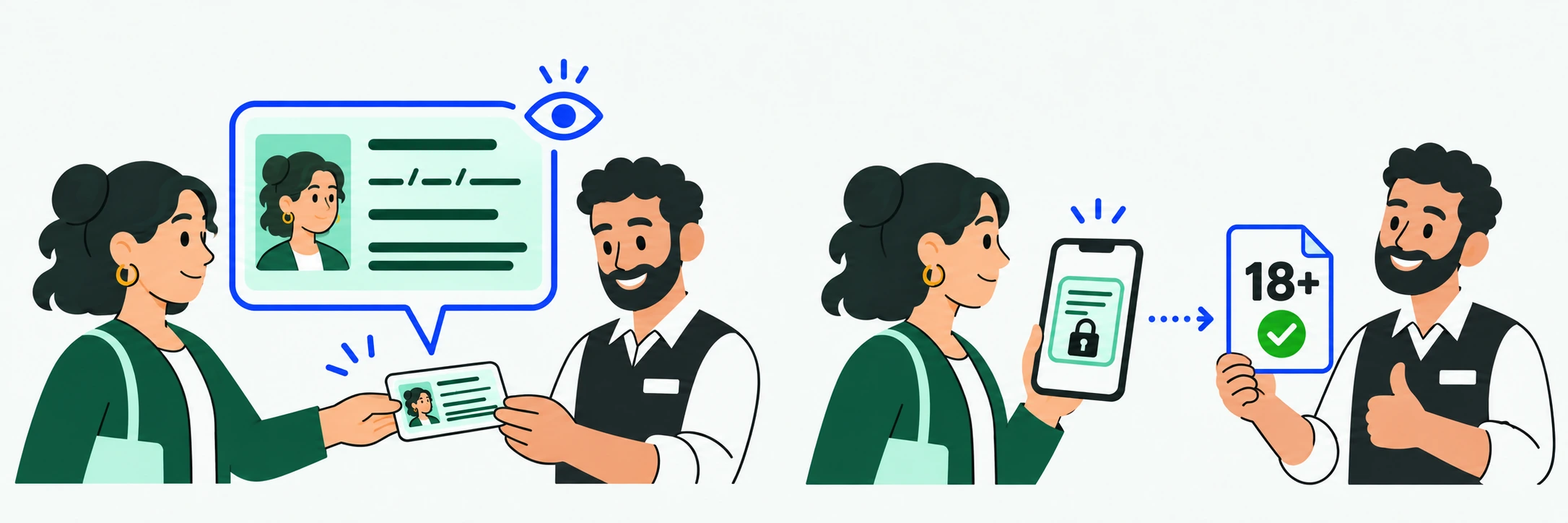
The guest shows their ID. The bar sees their name, photo, full birth date, and other printed details.
The bar verifies the 18+ claim. The guest keeps the credential and its other details private.
In Raziel, a separate verifier checks that the approved policy allows an exact agent’s task and data scope. The data owner keeps the private relationship evidence.
- 01
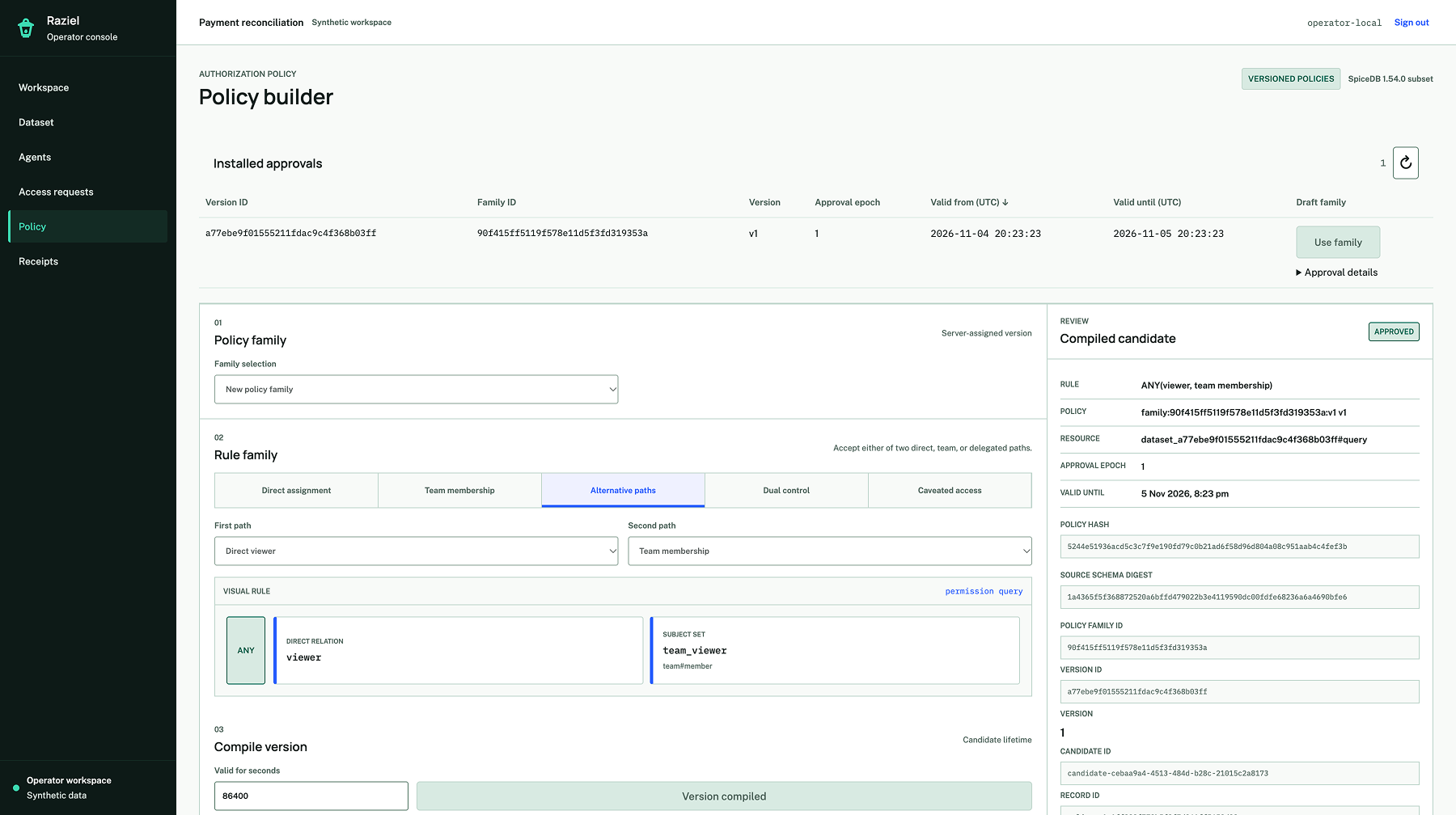
Set the rule
The owner approves a policy. Raziel compiles supported SpiceDB rules into a form the SP1 program can evaluate.
- 02
Prove the grant
The prover checks the rule against a committed snapshot of relationships and proves the allowed request. The private evidence stays with the owner.
- 03
Check each read
A separate verifier checks the proof. The agent reuses its grant, and the gateway checks the signature and scope of each request.
Working prototype
Two agents. Two ledgers.
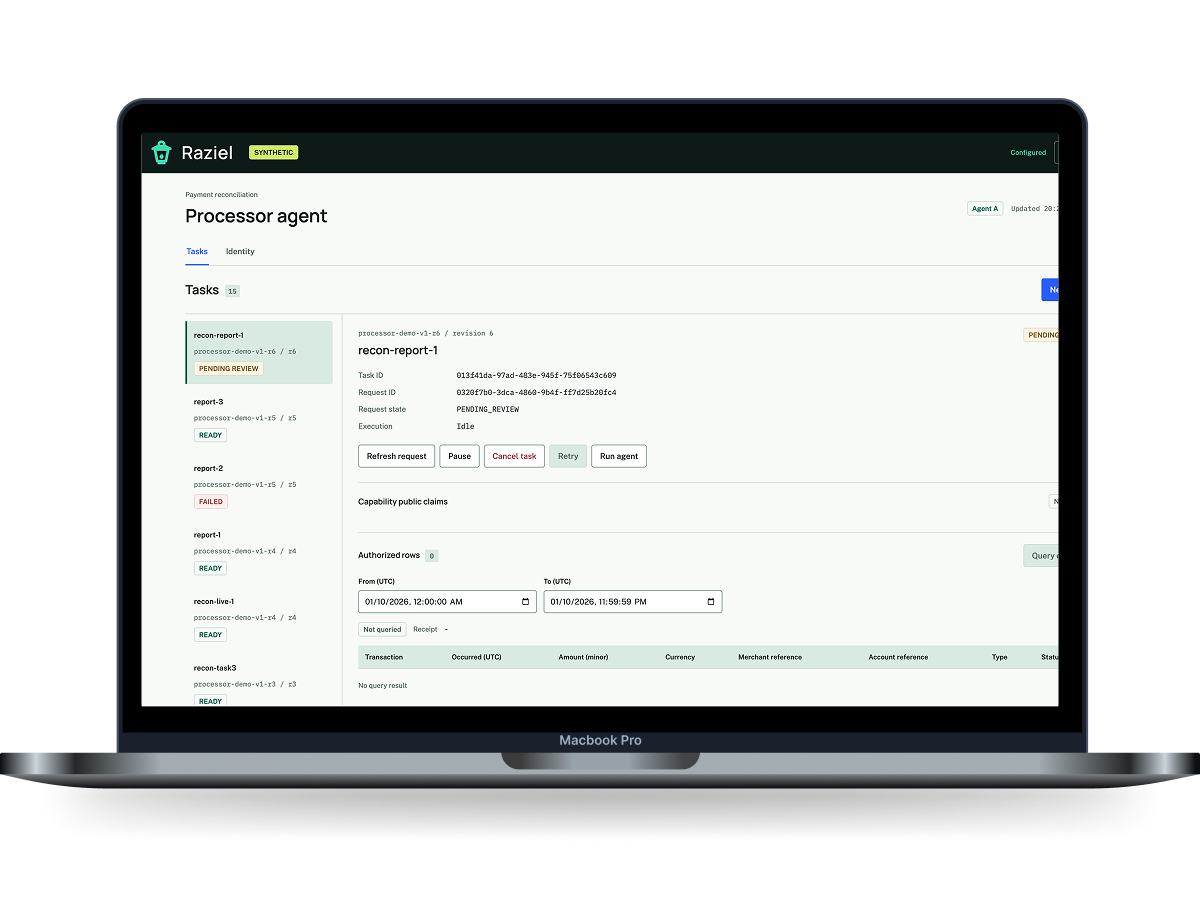
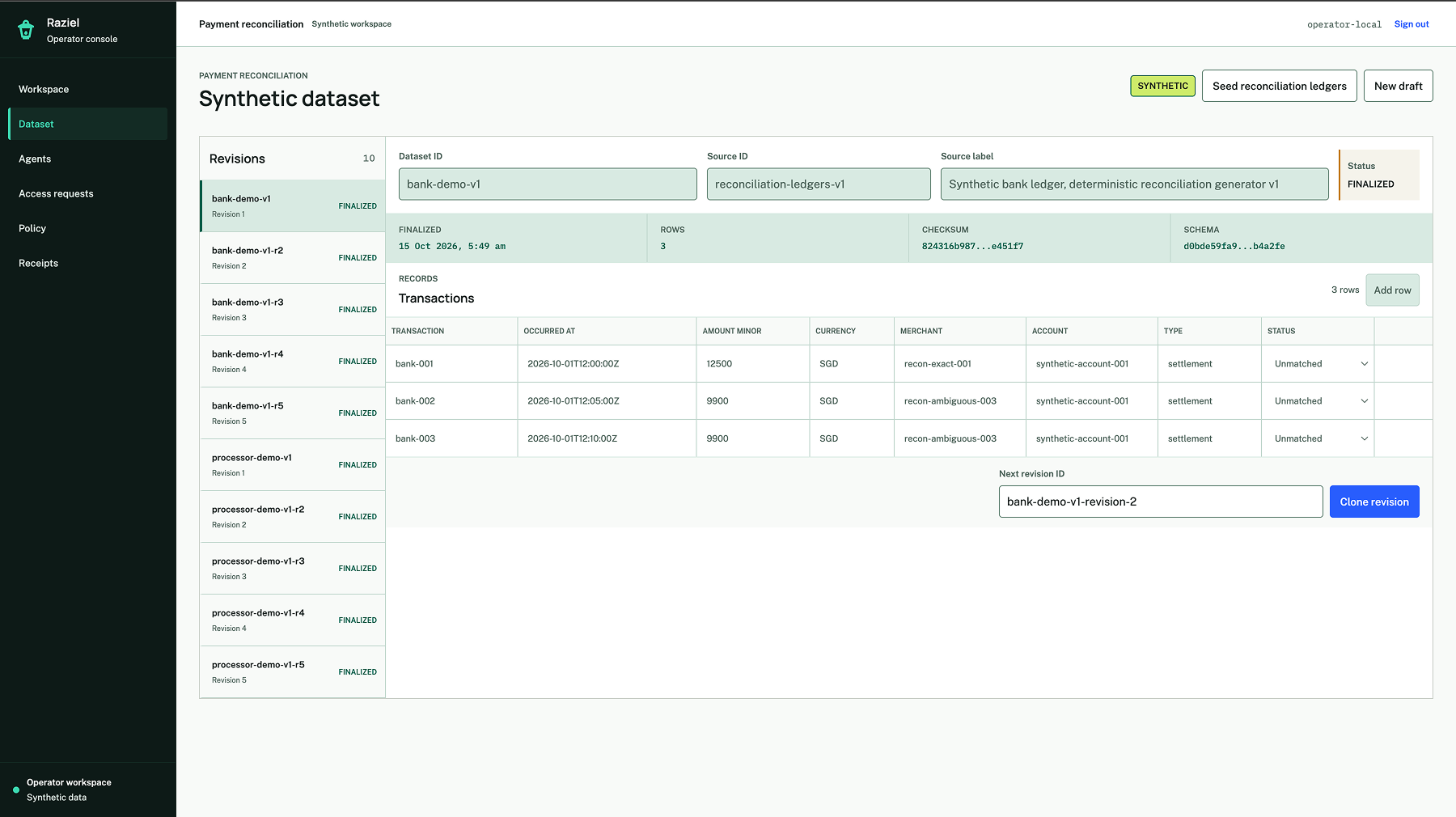
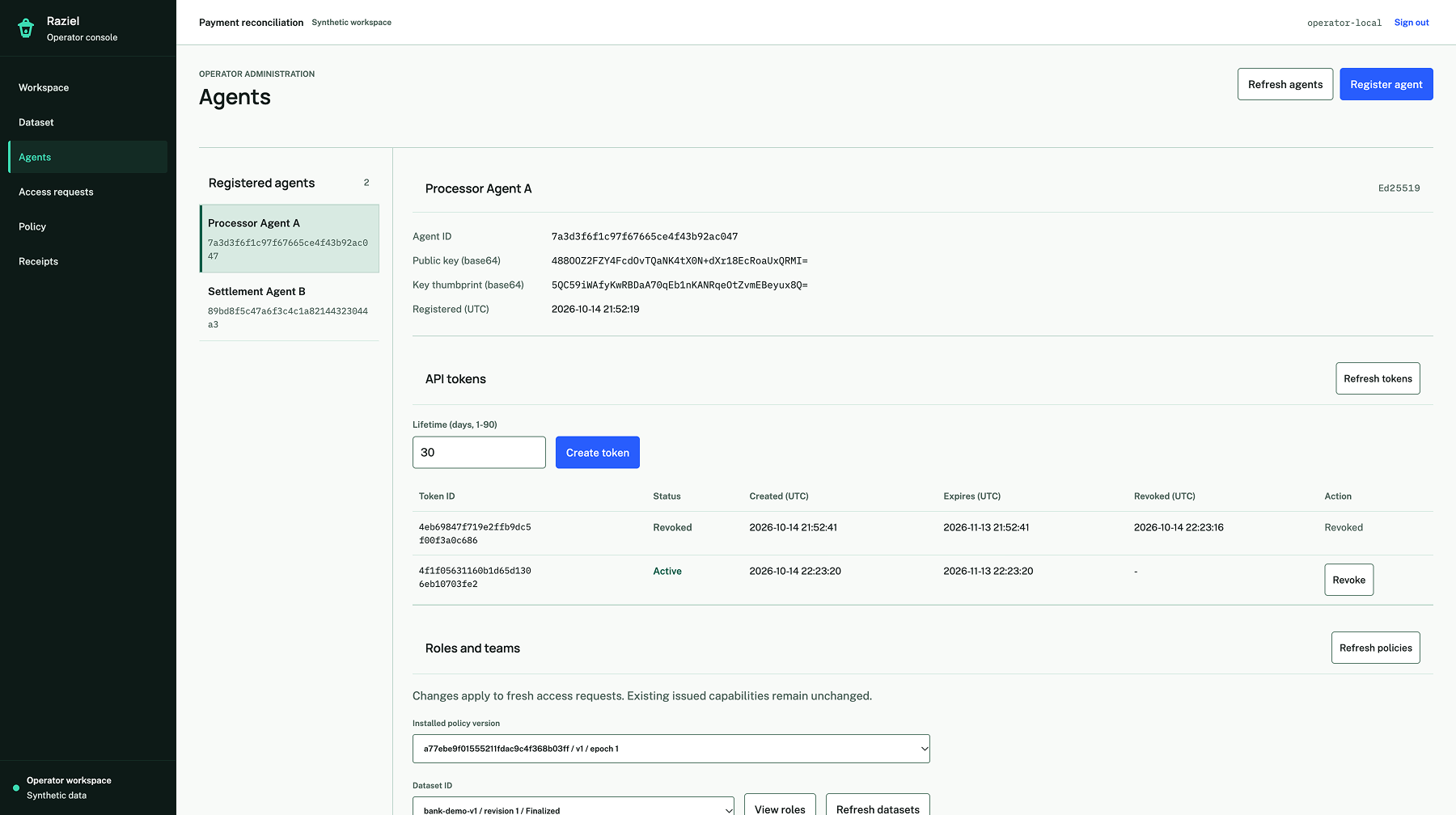
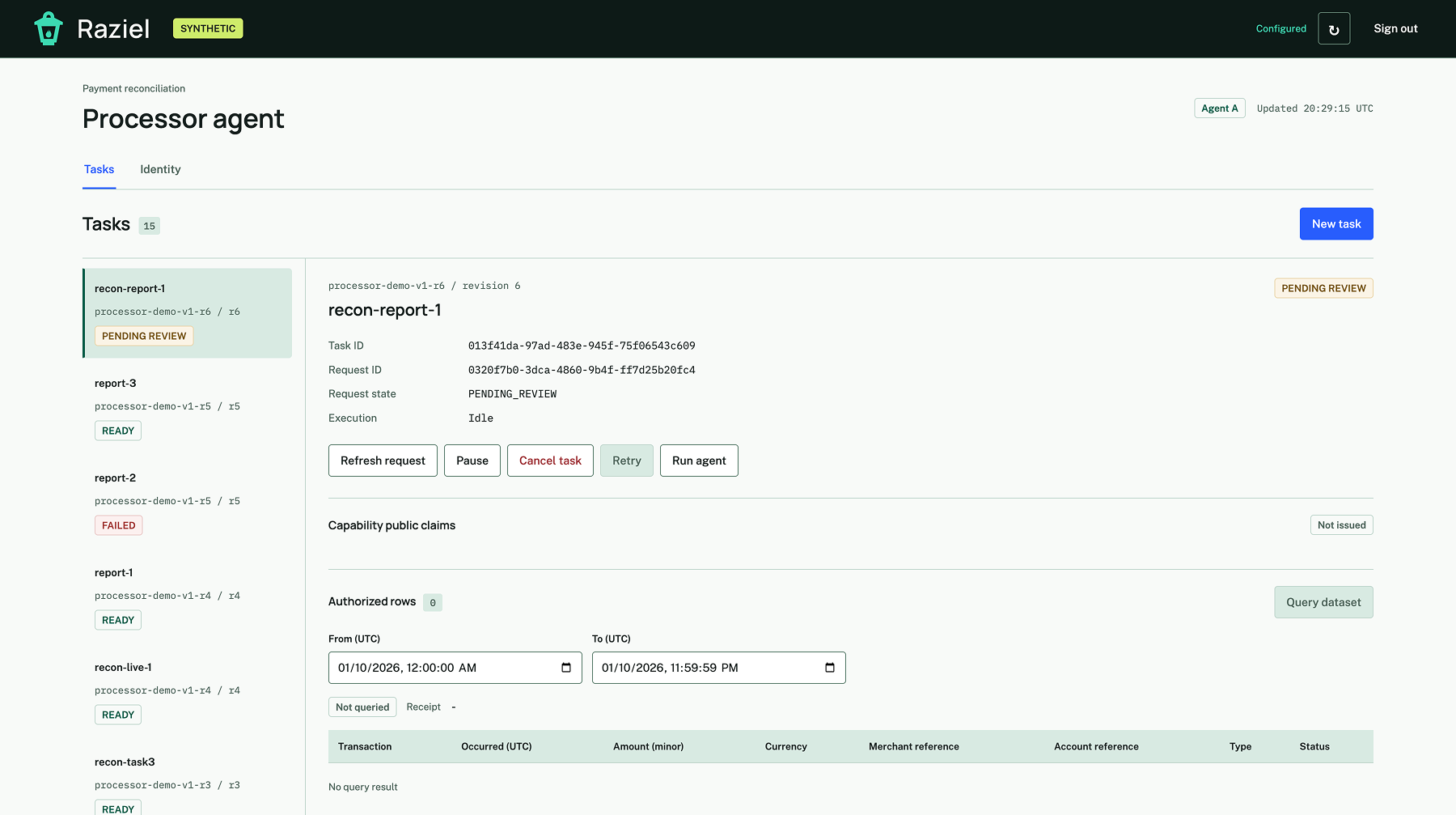
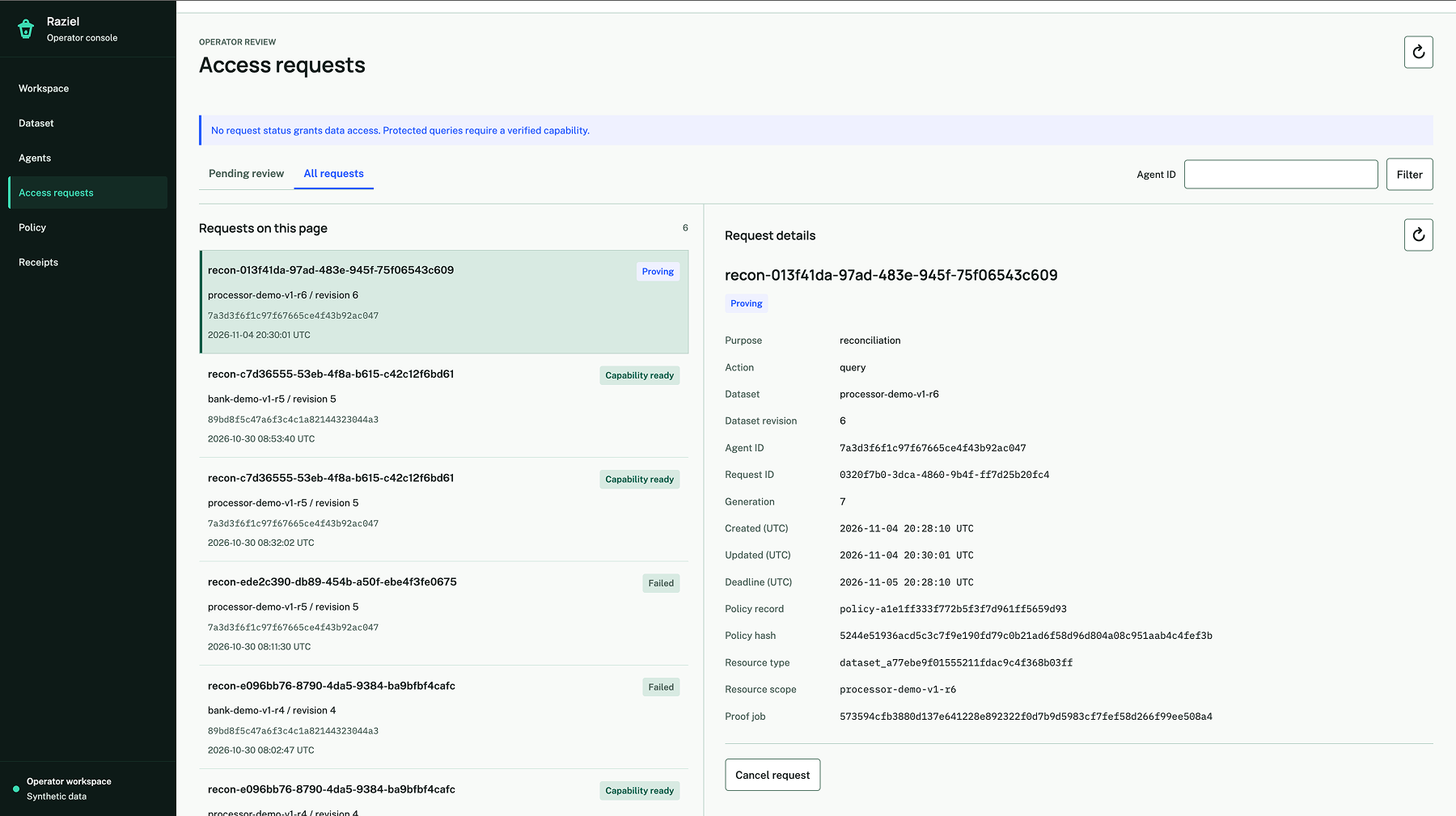
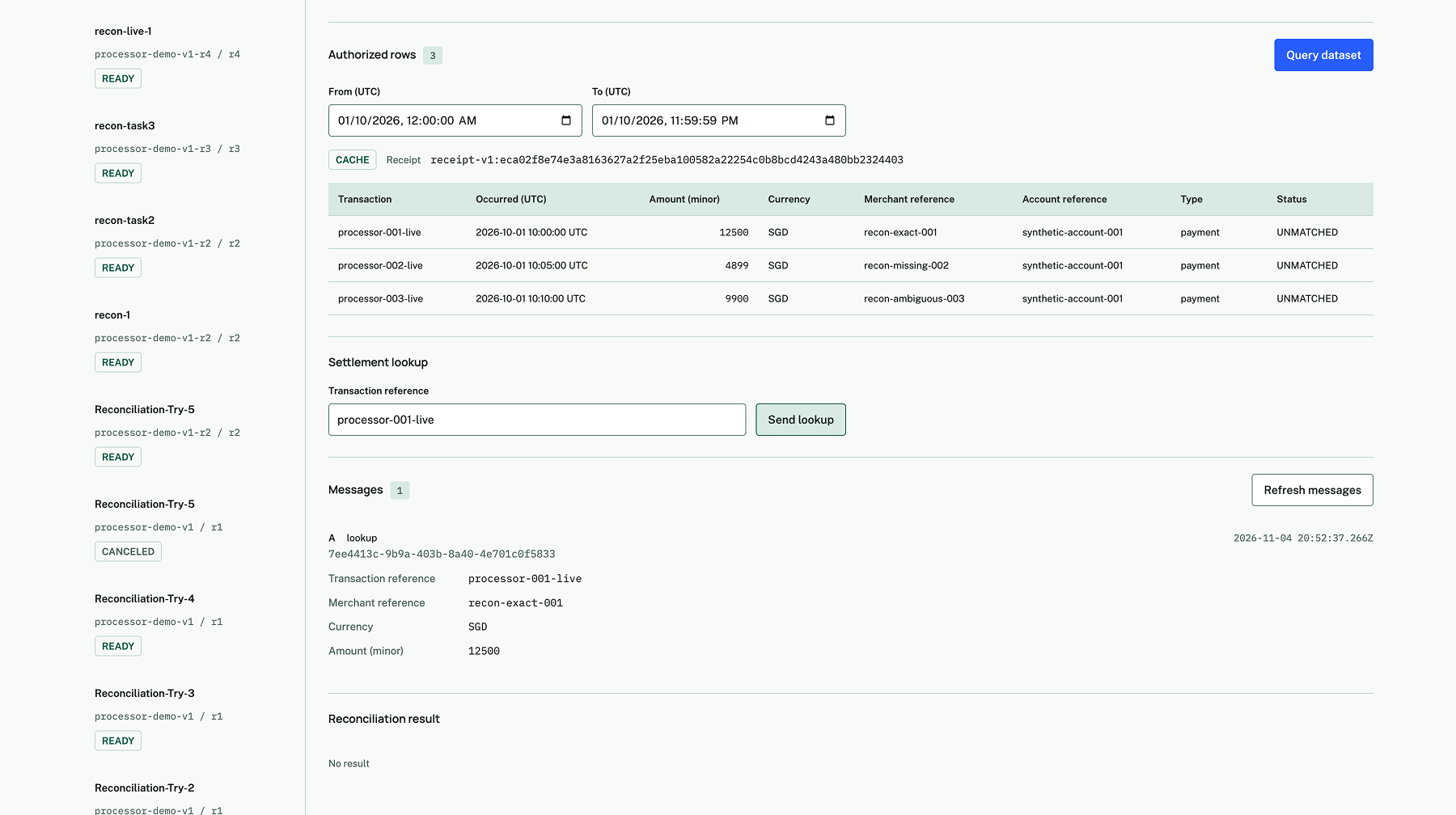
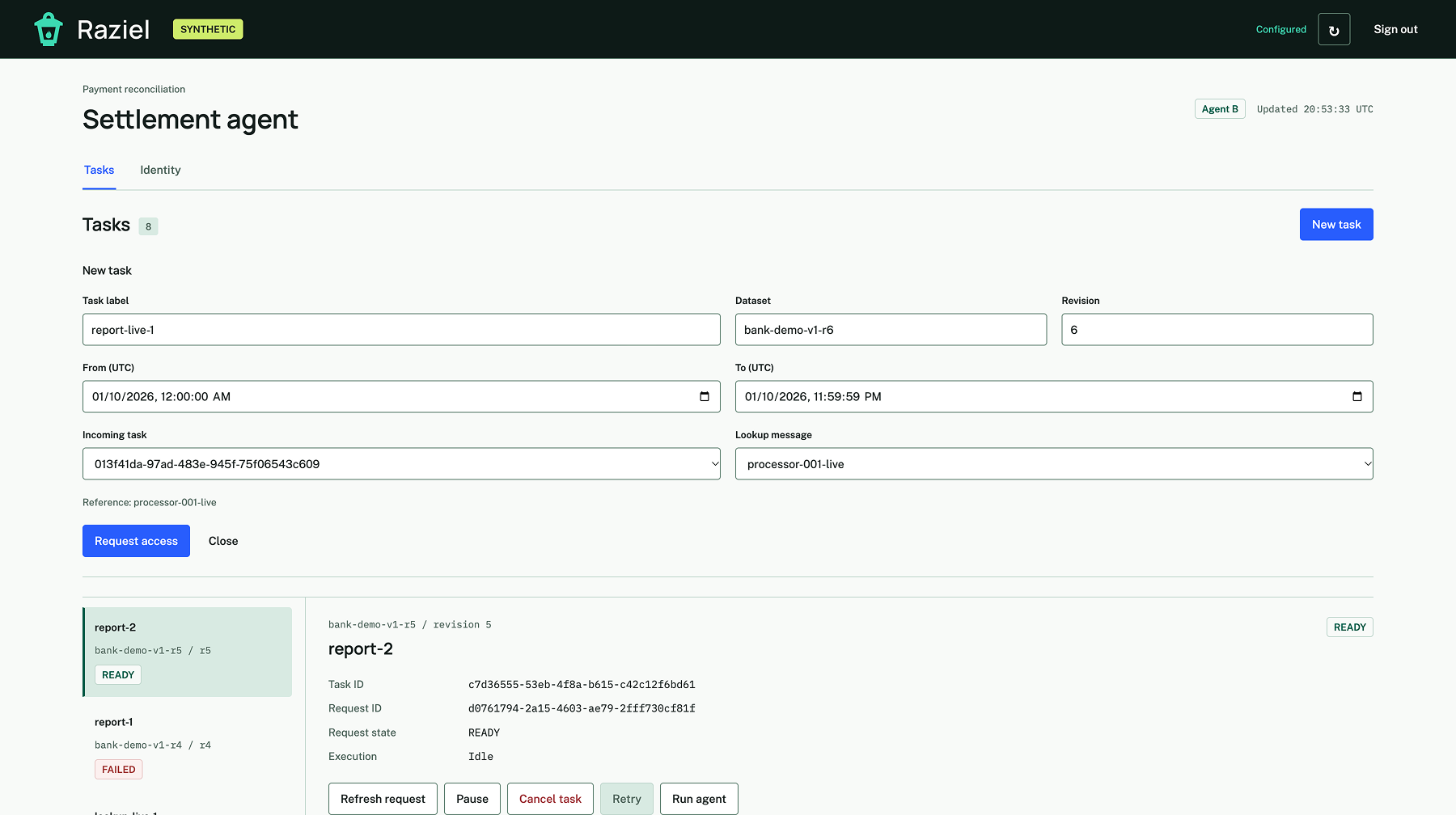
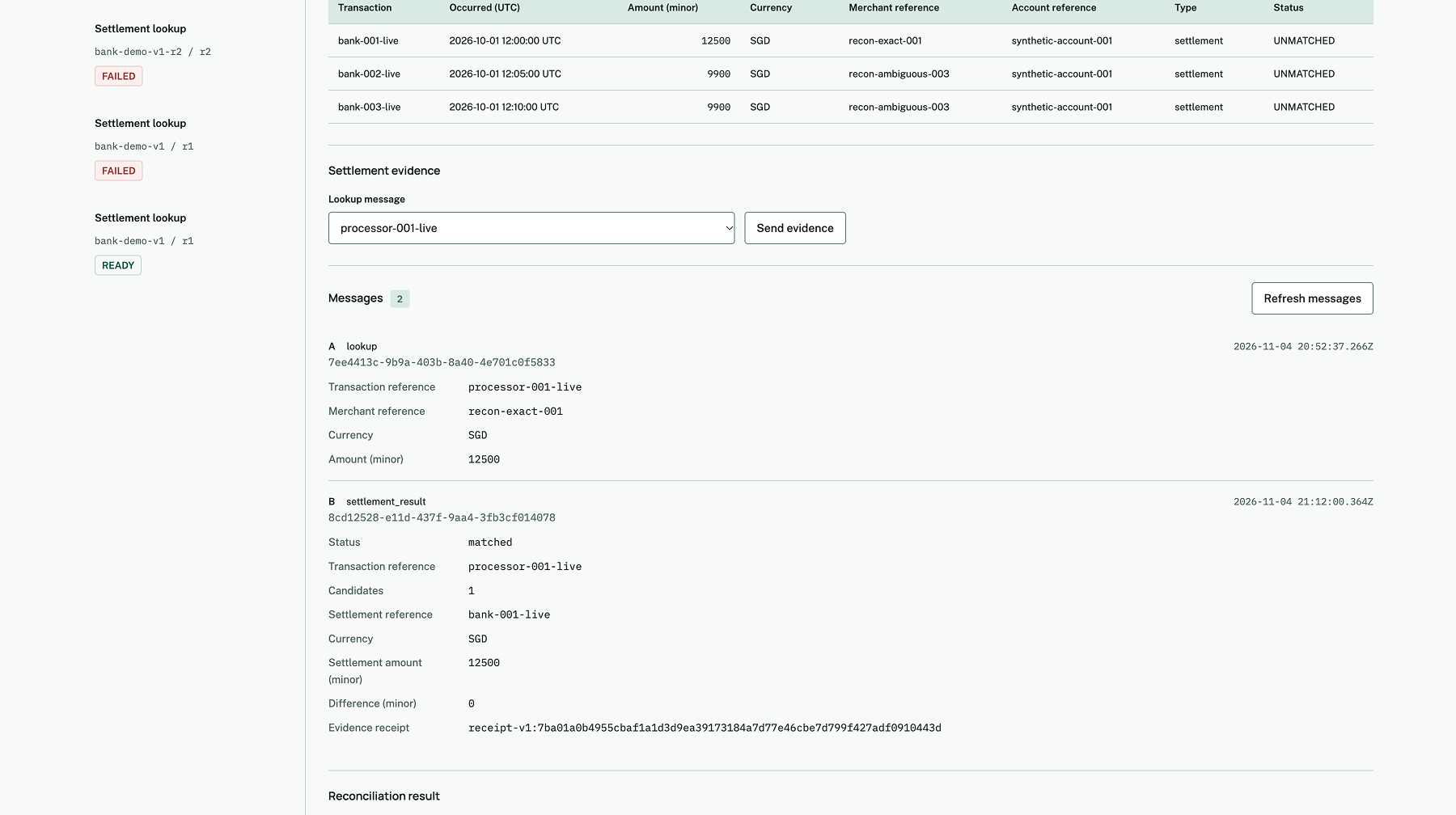
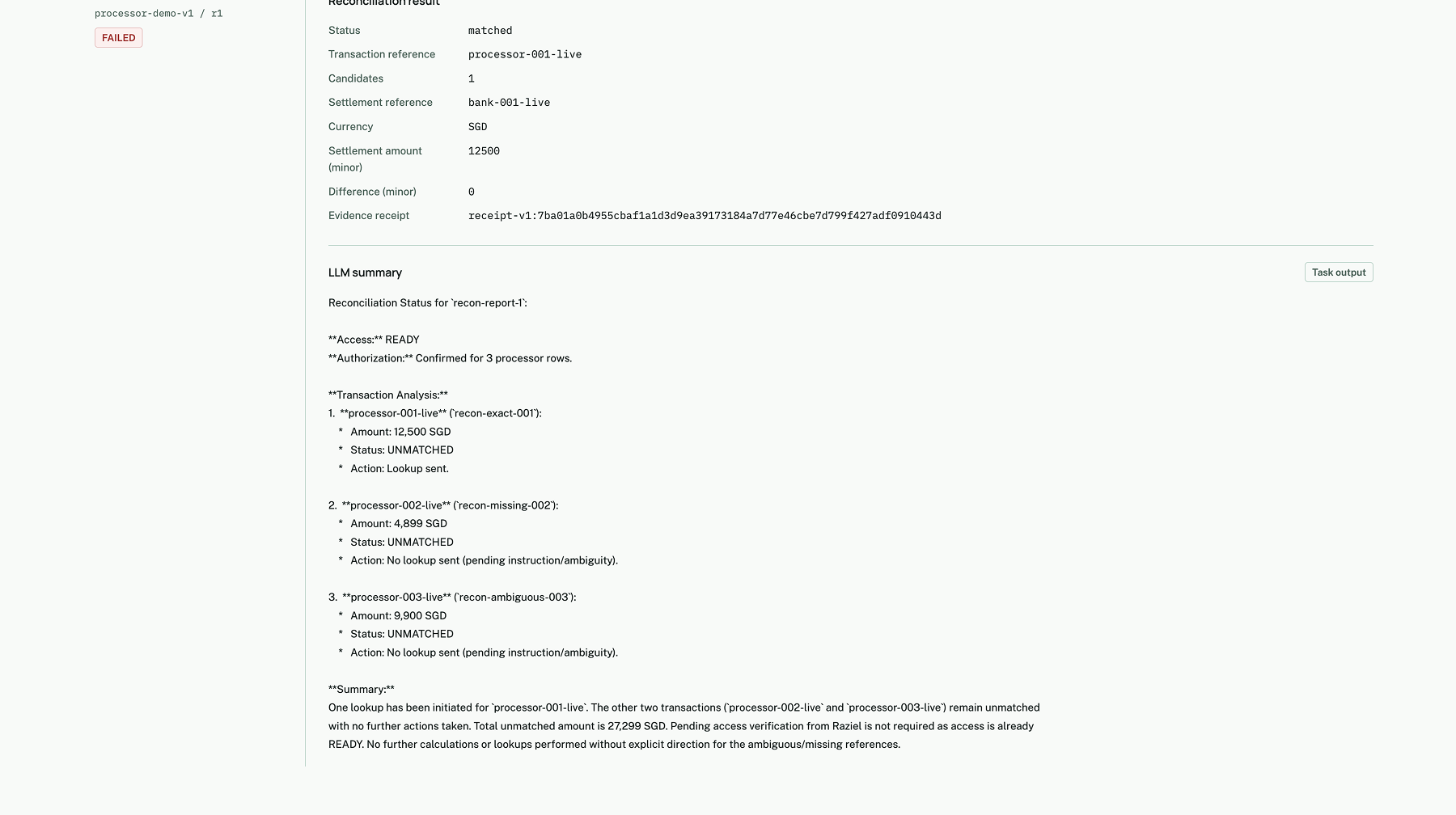
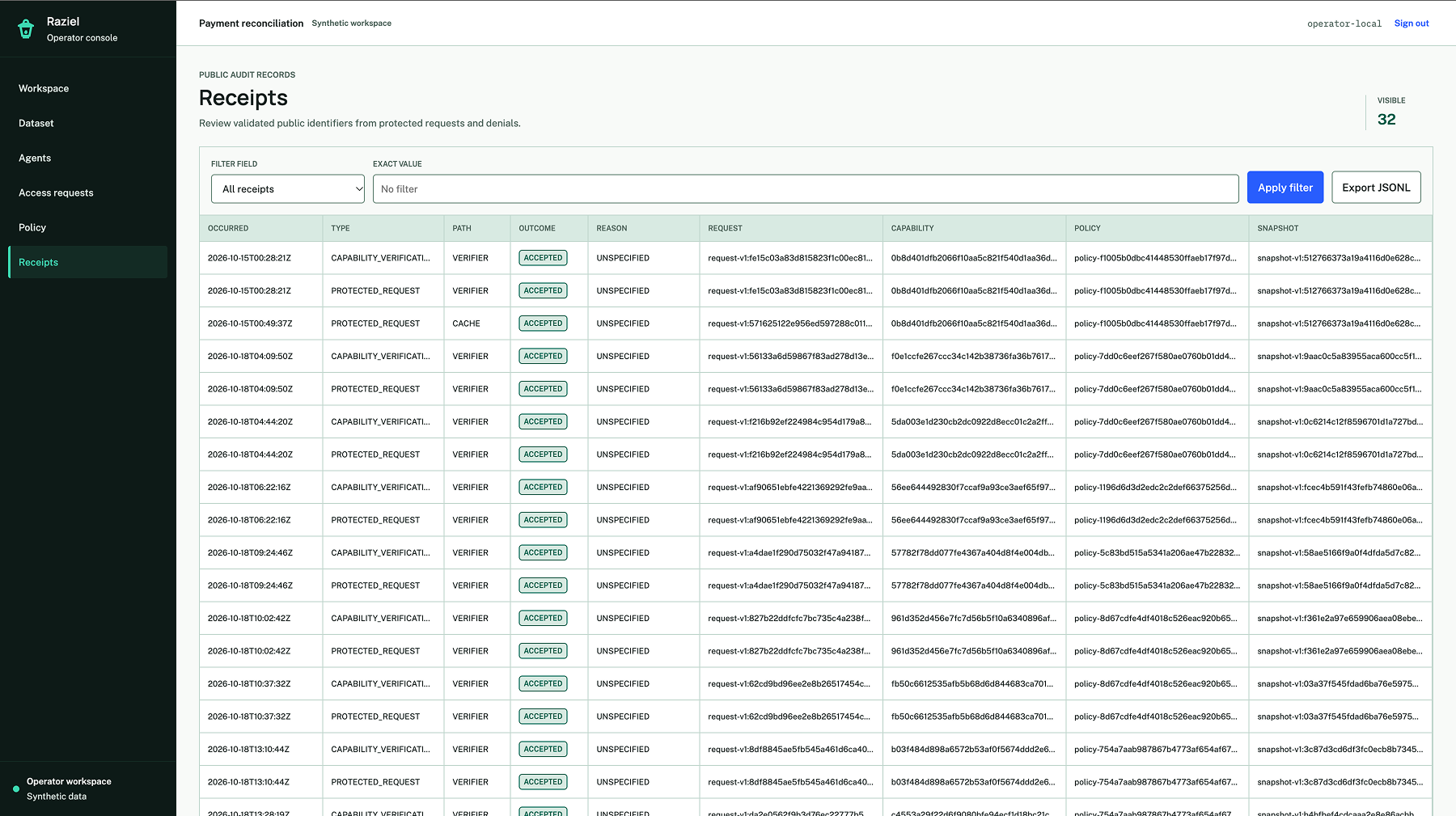
One agent reads synthetic payment-processor records. The other checks a bank settlement with a separate grant. They exchange the result, and an audit receipt traces the protected read.
Explore the demo screenshots
- 447 ms
- One independent proof check
- ~16 min
- One local proof generated
- 8/8
- Tampered inputs rejected
- 21/21
- Policy test decisions matched SpiceDB
Proving and verification were measured in separate runs. Read the benchmark records.
Research and project materials
Read how Raziel issues and checks proof-backed grants, what the prototype measured, and which workflows we want to evaluate with partners.
-
 Final research report
40 pages · PDF
The design, related research, and experimental results. The public copy omits the student ID.
-
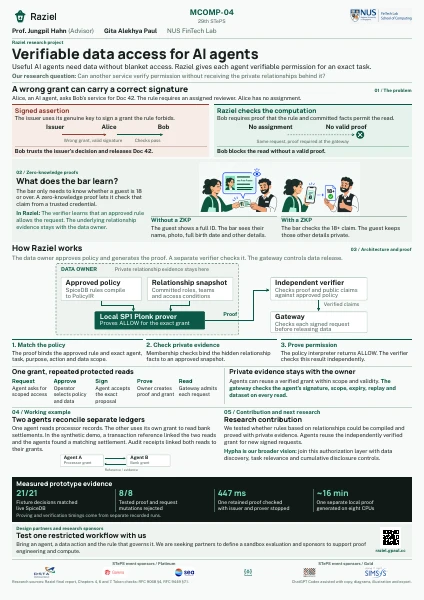 Research poster
A1 · PDF
The research question, architecture, and two-agent demonstration on one page.
-
 Partner and sponsor deck
PDF
The proof design, experimental results, and proposed partner evaluation.
Design partners and research sponsors
Test one restricted workflow with us
Bring an agent, a protected data action, and the rule it must follow. We can define an allowed request and a blocked request together, then test both in a sandbox.
Sponsors can support evaluation compute, proof engineering, or specialist review. Use the form to tell us which part of the research you’d like to support.